
NIS Introduces Patented InLighten™ Technology as Research Confirms Fiber-Optic Eavesdropping Threat
HICKORY, N.C., August 3, 2026 — The fiber-optic cable running through a secure facility may be carrying more than data. Under the right conditions, it can also capture audio.
Recent cybersecurity research has demonstrated that Distributed Acoustic Sensing, or DAS, can transform standard telecommunications fiber into an optical microphone. By sending laser pulses through a fiber and analyzing the light reflected back, DAS systems can detect minute vibrations along the cable—including vibrations created by human speech.
Network Integrity Systems Inc. is responding to the emerging threat with InLighten™, patented technology designed to detect Eavesdropping over Fiber, or EoF, before sensitive conversations are compromised.
“This changes the way secure organizations need to think about fiber,” said Dave Cunningham, president of Network Integrity Systems. “A traditional listening device must be placed inside or near the protected space. With Eavesdropping over Fiber, the cable already running through that space can become the collection mechanism. There is no microphone, transmitter or electronic device inside the room for a security sweep to find – the electronics can be dozens of miles away.”
A threat moves beyond theory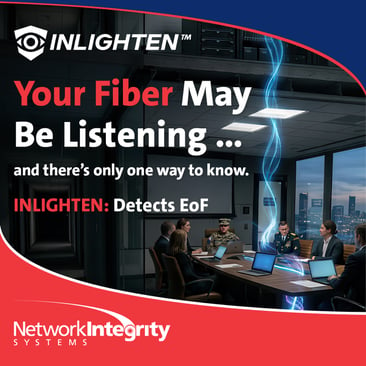
DAS is widely used for legitimate purposes, including detecting earthquakes, monitoring pipelines and protecting perimeters, utilities and long-haul communications routes. The technology sends rapid laser pulses through optical fiber and analyzes changes in the reflected light to detect vibrations along the cable that would indicate an intrusion or damage to the fiber.
The security concern arises when that same acoustic sensitivity is directed toward capturing speech.
Researchers presenting at the 2026 Network and Distributed System Security Symposium demonstrated that commercially available DAS equipment could be used to recover conversations occurring near telecommunications fiber. Their experimental system reported speech intelligibility above 80% under tested conditions and operated with more than 50 meters between the attacker and target.
In May, Science reported separately that researchers recovered intelligible speech from unused, or “dark,” telecommunications fiber. The report showed that artificial intelligence transcription tools could help convert faint fiber-borne signals into readable conversations.
NIS has conducted independent research and testing into EoF and says its demonstrations recovered clear conversations, confirming that the threat has advanced beyond the garbled audio associated with some earlier generations of DAS equipment.
Performance varies based on cable construction, installation conditions, acoustic environment, and signal-processing methods. However, the published research, as well as NIS’ own proprietary research, demonstrates that fiber-based acoustic collection is achievable using commercially available technology.
An attack from outside the security boundary
An attacker needs access to one end of a suitable fiber, but that access point may be outside the facility’s primary security boundary—at a demarcation point, junction box, manhole, carrier vault or central office.
Sensing light can travel through an existing optical path toward the protected facility. Fiber near a sensitive conversation can pick up the vibrations of speech and return information to a remotely located DAS interrogator.
No connection to the organization’s network equipment is required. Dark fiber that has never carried legitimate traffic can provide the path to the desired recording location.
This creates a particular concern for classified facilities, Sensitive Compartmented Information Facilities and other secure environments. Because the technique does not require a conventional microphone or radio-frequency transmitter inside the room, it may not be discovered through a traditional physical, acoustic or RF sweep. The cable itself becomes the sensor.
Detecting the light required to listen
Eavesdropping over Fiber has one unavoidable requirement: An attacker must inject sensing light into the fiber. InLighten is designed to detect that light.
The technology continuously monitors unused fiber and alerts security personnel when it detects optical signals indicative of an attempt to use the fiber for acoustic sensing. Rather than relying solely on passive measures intended to reduce acoustic sensitivity, InLighten provides real-time visibility into whether a potential monitoring attempt is underway.
The technology is protected by U.S. Patent No. 12,615,084, “Securement of Optical Fibers Against Eavesdropping Using Monitoring of Signals on a Fiber,” issued to NIS on April 28, 2026. Additional patent applications related to EoF mitigation are pending.
“InLighten is built on a simple physical reality,” Cunningham said. “If someone wants to listen through the fiber, they must introduce sensing light. Our cost-effective technology is designed to recognize that light and raise the alarm. When connected to the dark fibers entering a facility, InLighten ensures that critical conversations aren’t subject to EoF”
InLighten complements NIS’s INTERCEPTOR™ Alarmed Protected Distribution System technology, which protects monitored classified network infrastructure against tapping, tampering and physical attack.
NIS will demonstrate InLighten at Booth 321 during TechNet Augusta, Aug. 17-20 at the Augusta Marriott at the Convention Center.
About Network Integrity Systems
Founded in North Carolina in 2003, Network Integrity Systems develops optical sensing technologies that protect classified networks, critical infrastructure and other mission-critical assets. NIS technology continuously monitors fiber-optic cables, pathways and vulnerable access points for activity that may indicate tapping, tampering, intrusion, infrastructure damage or other physical cyber threats. NIS is headquartered in Hickory, North Carolina.
For more information or a demonstration, contact us.
.png?width=760&height=760&name=Proud%20FOSA%20Member%20(1).png)