
When customers ask about sensing performance—especially in challenging environments like busy roadways, utility rights-of-way, or dense infrastructure corridors—they often expect a simple answer.
“How far can you detect?”
“How sensitive is it?”
“What’s the false alarm rate?”
At Network Integrity Systems, our answer is often: “It depends.”
And that’s intentional.
Real-World Conditions Aren’t a Lab
Many sensing specifications in the market are based on ideal conditions—controlled tests, quiet environments, or perfectly isolated fiber. Those numbers can look impressive on paper, but they rarely reflect what happens in the field.
 Because the field isn’t pristine.
It’s noisy.
It’s unpredictable.
It’s full of traffic, heavy equipment, wind, vibration, and environmental interference.
Performance beside a highway looks very different than performance in a lab. Detection along a utility right-of-way behaves differently than inside a test spool. False alarm rates change depending on soil type, installation methods, and surrounding activity.
In fiber optic sensing, context matters. A lot.
Testing Before Promising
Rather than making blanket claims, we take a different approach: we test the actual scenario first.
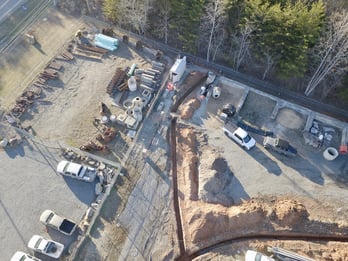 Our dedicated testing facility allows us to recreate real-world conditions and evaluate how systems truly perform—before they’re deployed in the field. We simulate noise, vibration, and operational environments so we can understand:
- What can actually be detected
- What can be reliably classified
- What will create nuisance alarms
- And what performance looks like in practice—not theory
This isn’t just for our own solutions. We routinely test with:
- End users
- System integrators
- Technology partners
- Manufacturers evaluating integrations
We help them see exactly how their system performs and how it compares.
Because trust comes from proof, not promises.
Why This Matters
Overpromising sensitivity or accuracy can create bigger problems than underperforming hardware. False alarms waste time. Missed events create risk. Unrealistic expectations erode confidence.
Critical infrastructure protection demands certainty.
 Whether it’s protecting:
- Long-haul fiber routes
- Data center interconnections
- Utility rights-of-way
- Government and military perimeters
- Energy and critical infrastructure assets
…the solution must work in the real world, not just on a spec sheet.
A Trusted Partner, Not Just a Vendor
At Network Integrity Systems, we don’t guess—and we don’t sell based on theoretical numbers.
If we say a system will perform, it’s because we’ve tested it.
If we recommend a configuration, it’s because we’ve validated it.
And if the answer is “it depends,” it’s because we’re committed to giving you the truth.
Because when protecting critical infrastructure, accuracy matters more than marketing.
That’s why customers and partners trust us—not just as a sensing provider, but as a solutions partner.

.png?width=760&height=760&name=Proud%20FOSA%20Member%20(1).png)